Section 01
You already fund this function
The change is not that design suddenly needs an AI strategy. The change is inside the function you already pay for. First drafts got cheap. Screens, variants, teardown notes, and prototype code can arrive before anyone has judged them. What got scarce is judgement: what is worth making, which capability may run, and who answers when it ships.
A CEO does not fix that by learning the tools, and does not fix it by sending the head of design to a general certificate and waiting for a capstone. The account is short enough for a board. Production is no longer the scarce resource. Judgement is. The four practices you already fund are still research, product design, design engineering, and the design system. Each one has work an agent can draft and a gate a person still holds.
If the reply you receive is a tool list, you do not yet have the account. You have a production story.
Section 02
Three decisions that do not delegate cleanly
Most of the daily work stays with design. Taste, the critique, the harness, the promotion of a prototype, the contribution rule on the system: those are not your meeting. Three decisions are, because a head of design cannot make them alone without borrowing authority you have not given.
The judgement budget. Headcount can buy more production, or it can buy time to judge. You do not have to promise a smaller team. You do have to say where review time goes, and protect it. A CEO who funds the time and then joins every critique has taken the time back.
The systems in bounds. Repositories, design files, client material, live tools. Which of those an agent may touch is a control decision, not a prompt. Design still runs the harness and the daily gate. You settle the list. An unlisted system means stop.
A named human. When agent-made design work ships, someone answers. One name. Duties before new job titles. You can name your head of design. You still have to be the person who accepts the name. Design still runs the critique itself.
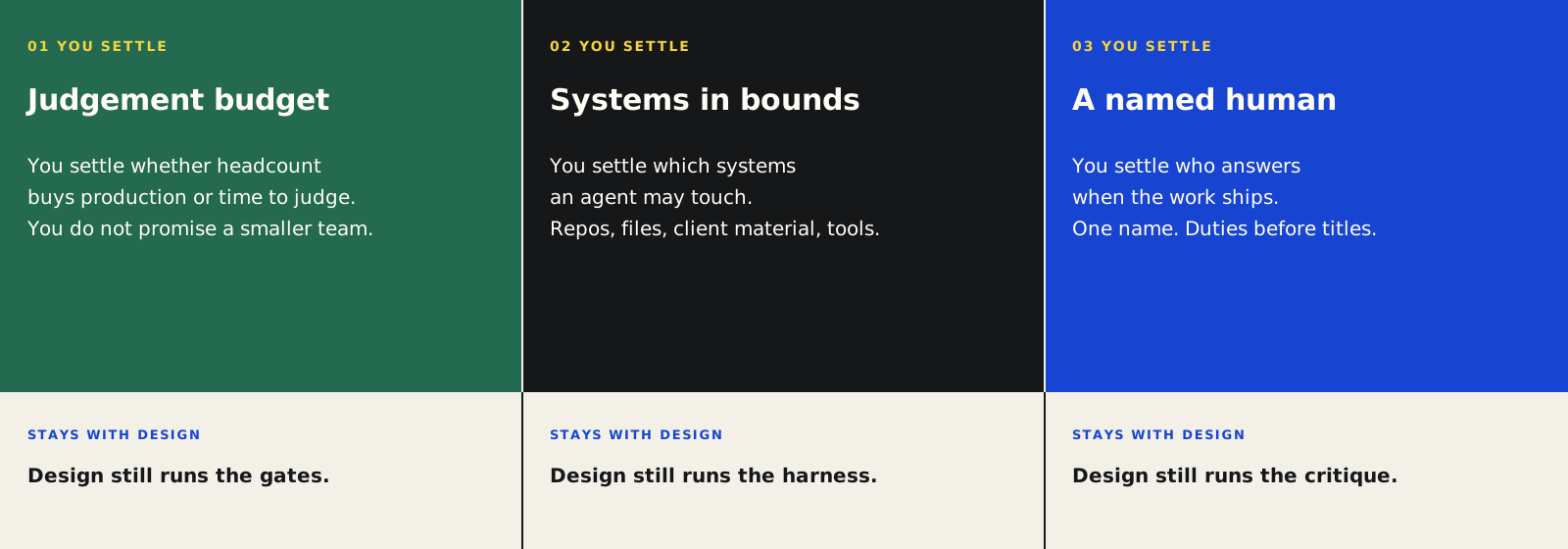
Green is the budget. Ink is the systems list. Blue is the named human. The paper band under each column stays with design.
Section 03
Where value sits, and where harm sits
Value, if the gates exist, is ordinary. Cycle time on the right problems. A faster draft of the wrong brief is not value. Consistency against the system you already have, because agents follow written rules or they invent. Desk-research throughput, with interpretation still belonging to the researcher.
Harm, if the gate is empty, is also ordinary, and it does not wait for a strategy offsite. Unreviewed output that looks finished. Client material that entered a prompt because a folder was mounted. Generative media standing in for a customer: likeness, brand, invented footage. Fake research: a quotation nobody said, in the mouth of a persona. Computer use: an agent allowed to operate a tool on the machine, with no list of systems.
You can ignore a great deal of product news. You cannot ignore a class that is already running with no rule. Ask which classes are in use, including the ones procurement does not know about. Hear them as classes. A product name is an example, dated, not a tutorial you are expected to finish.
Section 04
A certificate is study, not the plan
A general executive AI program is sold as a multi-week online course for executives and function heads, with a capstone, a certificate of completion, and live sessions. An executive AI certificate may run as a longer series that pairs leadership with product design, with a credential for each course. Those offers put a price, a duration, and a credential on the page. They are aimed at leaders who want a general education in the topic.
Take one if you want that education. Decline it as the operating plan. A serious certificate does not settle your judgement budget. It does not list the systems your agents may touch. It does not name the human who answers when a design artifact ships. Those three lines are yours. A capstone pitch in a board pack is not a substitute for them. If the pack depends on a demo, send it back.
This school will not imitate the cohort, the faculty line, or the certificate. The short course for a CEO is written lessons you can reread. There is no start date. The three leadership courses, including this one, are sold together for US$300. The two longer courses are where the operating model and the quality bar are built.
Section 05
Case study: the offsite deck
A composite, not a client, and not a result you should quote as a number. Ahead of a strategy offsite, someone asks an agent for the customer section of the leadership deck. The agent can see a folder that holds a client research transcript. Nobody has written whether client material may enter a prompt. The draft comes back with a quotation nobody said, attributed to a synthetic persona, and a generated photograph standing in for a customer. The agent has also been allowed to operate the slide tool. The deck looks finished, so the first human look is the offsite itself.
That is five failures in one artifact. Unreviewed output. Client data. Generative media. Fake research. Computer use. Speed was real. The account was not. The audience cannot tell a finding from an invention.
The repair is not a better prompt. It is the three decisions, written down before the next offsite. Client material is either in bounds or it is not. A persona is not evidence. Invented footage is a commission, not a convenience. Someone is named. The head of design is asked for an operating model, a quality bar, and a risk list, on a date. A tool-rollout reply is sent back before the demo starts, using language written in advance.
Section 06
What you ask for, in files
You do not need a program plan. You need three artifacts and a date about ninety days out. The operating model says who may run which class, on which systems, with which gate. The quality bar says what must be true before anything ships, including that a persona is not evidence. The risk list names unreviewed output, client data, generative media, fake research, and computer use, for the classes actually in use.
Keep your own note short. The decisions you settled. The decisions you refused to take back. The questions you will ask without learning the tools.
ceo-ask/
  decisions.md          # judgement budget, systems in bounds, named human
  ask.md                # operating model, quality bar, risk list, and a date
  send-back.md          # sentences that mean the reply is a tool rollout
  check.md              # questions you can ask without the tools
Section 07
The ask, on one sheet
Weeks one and two, your head of design inventories classes already in use, including shadow tools, and you leave with a list rather than a purchase order. Weeks three to six, one practice runs on a written harness with a human gate you can name. Weeks seven to twelve, review capacity is funded, the permission rule is signed, and the owner is the person you already accepted.
If the reply skips the inventory and starts with a mandate, it is the rollout. If it cannot name a gate that has stopped something, it is not a gate yet. If the measures are screens, seats, or prompts, send it back.
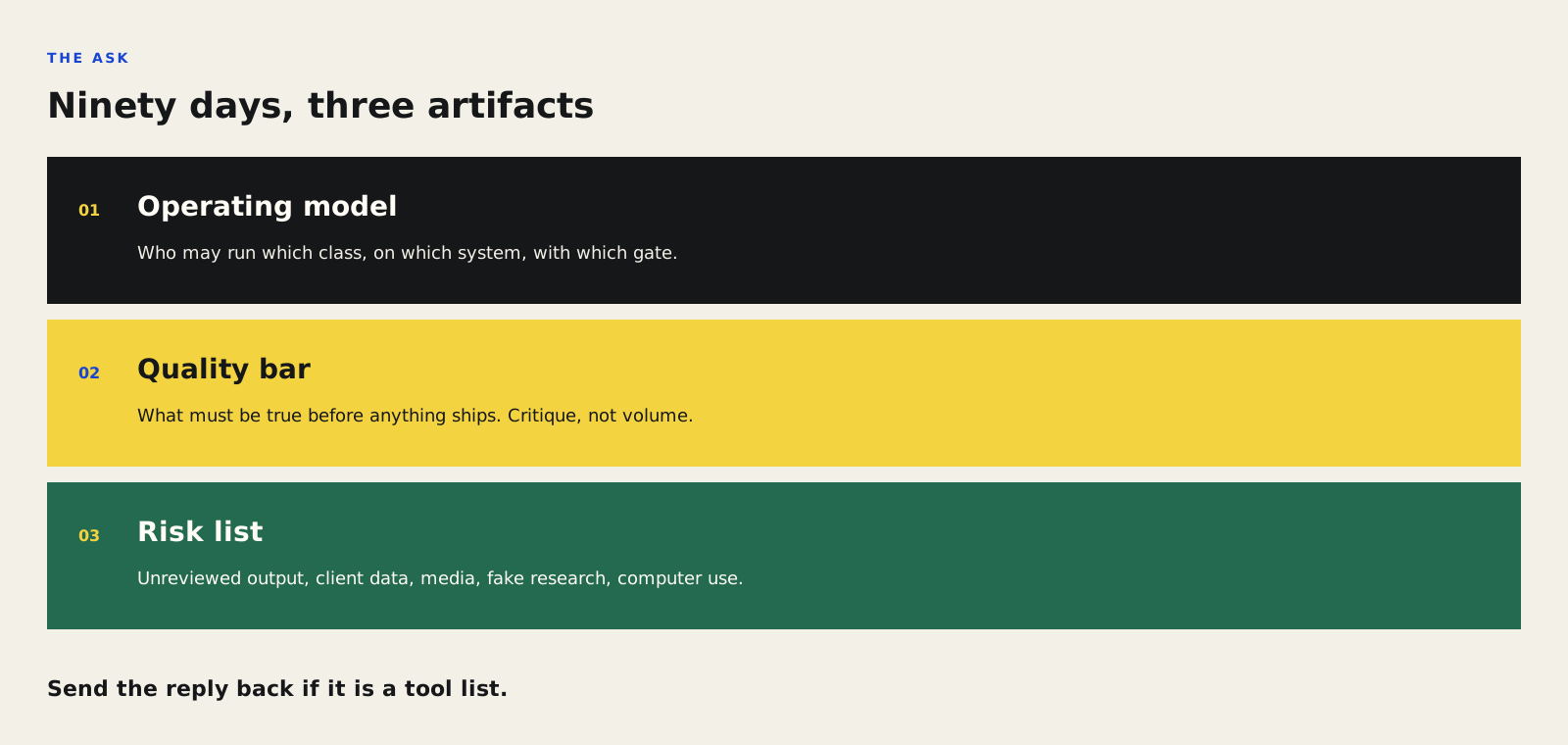
The ask is an operating model, a quality bar, and a risk list. A tool list is not any of the three.
Section 08
A good answer and a tool-rollout answer
You can tell them apart on the page, without a demo. Write the contrast down before the meeting so you do not invent the standard while someone is presenting.
Good: classes in use, including shadow tools, with a date
Good: a judgement budget that names where review time goes
Good: a list of systems in bounds, and a stop for the rest
Good: one named human, duties before a new title
Good: an operating model, a quality bar, and a risk list
The check does not require you to use the tools.
Section 09
Language you can send
Write the ask in your own voice. The block below is a template, not a memo that has been sent. Replace the date. Do not add a tool.
Ask
By [date, about ninety days out], send three pages:
1. Operating model. Who may run which class, on which systems, with which gate.
2. Quality bar. What must be true before work ships. Critique capacity, not volume.
3. Risk list. Unreviewed output, client data, generative media, fake research, computer use.

I will settle, separately: the judgement budget, the systems in bounds, and the named human.
I will not pick a vendor, supply taste, or decide whether a synthetic user counts.

Send back if you hear
- a tool list where the operating model should be
- a savings claim where critique time should be
- a demo that has to be seen before the page can be read
- a certificate offered as the plan
Section 10
Leave the craft where it belongs
You will be offered a longer education than this. Some of it is good. The designer-track courses on this site are for the people who practise: briefing, prototyping, critique, research packets, the design system, coding agents. Do not take those in their place, and do not assign them as a substitute for the three decisions.
The two longer courses are how a head of design answers you: the operating-model page, and the note they sign. This short course is the briefing. After it you can send a dated ask, and you can send back a tool list, a savings claim, or a demo.
The three are sold together for US$300. You do not learn the tools, and you do not receive a certificate. You leave with the three decisions written down and the reply you will send back. A longer certificate can be serious study for someone else. It does not settle your judgement budget. Designer membership does not include these courses.
The limit is honesty. If you have not made the three decisions, do not describe the organisation as further along than the inventory. A blank systems list is a fact. A named human you have not accepted is a fact. Ninety days is long enough to write the pages and short enough that a tool-rollout cannot hide inside a transformation program.
Projects to inspect
Sources
Sources & further reading
- Design and Agents: Decisions for the CEO
The short executive course this essay introduces.


