Section 01
The queue is the problem
A product designer can ask for several directions before lunch. A researcher can receive a teardown and a synthesis draft the same day. A design engineer can have a working prototype in a scratch folder before the critique is booked. None of that is imaginary, and none of it is a decision.
The practical problem for a head of design is the queue that follows. Production of first drafts got cheap. Screens, variants, teardown notes, and prototype code arrive faster than a team can say which of them is worth making. Buying more seats does not supply intent, critique, permission, or a name on the work. Those four stayed scarce.
If you lead research, product design, design engineering, and the design system, this is your job now. It is not a second career in prompt writing. The designer-track courses on this site teach the craft. This argument is the operating model around that craft: which capability class may run, what a human must still gate, and the one page you can hand a CEO without asking them to learn the tools.
Section 02
Cheap drafts, scarce judgement
Name the shift in one sentence before you name a product. First drafts got cheap. Judgement did not. Judgement here is concrete. Intent is what the work is for, including what will be left out. Critique is a person saying which competent option fits this product. Permission is which class of capability may run, on which system, against which bar. Accountability is the human who answers when it ships.
The four practices you already own do not disappear. Research still has a question, a reading, and an ethic. Product design still has taste and a critique. Design engineering still has a promotion gate, because a working draft is not a release. The design system still has an owner, because a generated part is not the system. Agents can draft inside each practice. They do not hold the gate.
A design organisation does not win this change by announcing a tool. It wins by deciding which capability may run, against which bar, with a named owner. Seats buy production. They do not buy a point of view.
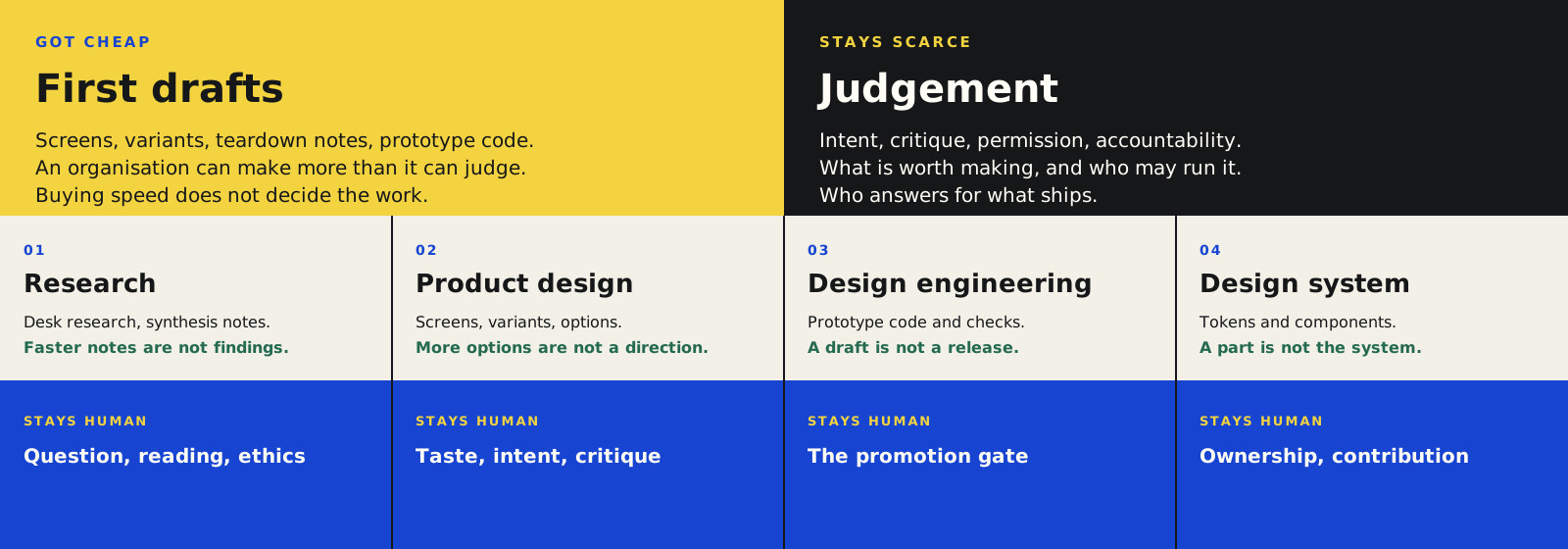
The top fields are the shift. The columns are the organisation you already run. The blue band is the human gate in each practice.
Section 03
What a certificate page is selling
Public professional programs in agentic AI are real, and they are built for a different reader. A general executive AI program is sold as a multi-week online course for mid-to-senior leaders across functions. The page lists learning outcomes from foundations through governance, a capstone that is either an integration plan or an executive presentation, a certificate of completion, and often live sessions and a program advisor. An executive AI certificate series may run longer, across leadership and product design, with a credential for each course.
Those are cohort products. Duration, price, faculty, and a credential are the offer. The curriculum is serious study for leaders who do not yet have a design-org account. It does not decide, for your research practice, what an agent may run. It does not tell your CEO which systems are in bounds. It does not hand you a page with duties instead of job titles.
Read that kind of program if you want that kind of study. Do not paste the certificate into the board pack and call it the operating model. A credential can sit beside the work. It cannot replace the sentence that says what this design organisation is for, or the gate that has actually stopped something.
Section 04
Case study: the week after the demo
This is a composite, not a client. A head of design sits through a vendor demo on a Thursday. By Friday three things are true that were not on the slide. A product designer has a browser tab generating screens against no written system. A design engineer has a coding agent on a repository that includes a client folder. A researcher has a synthesis that quotes a persona nobody interviewed. The demo had a name for the product. It did not have a name for the person who would refuse any of those three.
The first draft of the operating model, written that weekend, lists the tools. It reads like a shopping list with a date on it. The CEO asks which one to buy. That is the wrong question, and the page invited it. The second draft deletes the vendors from the sentence and writes the job: decide what is worth making, which capability class may run, and who is accountable for what ships. The inventory, kept in a separate file, still names the examples, dated, including the shadow tabs. The CEO packet does not ask the CEO to pick among them.
What changes in the organisation is not headcount. Review time moves onto the calendar for one practice first. The other three wait, even though they are messy. The gate is not real until it has stopped something. In the composite, the stopped thing is the persona quote. It does not go into the roadmap. The coding agent stays on the repository that does not hold client material. That is a permission, not a rollout.
Section 05
The files the page is made of
Keep the operating model short enough to hand over, and keep the evidence next to it so the page does not become fiction. One folder is enough. The page itself has five blocks and no vendor shortlist. The inventory is allowed to name products, because shadow use is part of the truth, and it is dated so it can go stale without pretending to be a strategy.
Do not invent a new job title to hold this. The duties are harness, review, system, research ethics, and permission. A person can hold more than one. The agent is never the name on the work. If the ninety days only gated research, the page says so. The other practices are marked not yet opened. That is a fact, not a failure.
design-org/
  operating-model.md      # five blocks: job, classes, gates, owners, measures
  inventory.md             # classes already running, including shadow use, dated
  gates/
    research.md            # what an agent may run, what a human must stop
  permission.md            # who may run which class, on which repos and data
  ceo-packet.md            # decisions you are asking for, and decisions you are not
Section 06
What the sheet is for
The sheet is a structure, not a filled client page. Block one is the job in one sentence, with no tool in it. Block two is classes in use, including shadow use, with examples dated and kept off the CEO's shopping list. Block three is the gates you have actually opened. Block four is owners as duties. Block five is how you will know, and the measures are judgement, refusals, and breaches. Screens generated are not a measure.
If a block cannot be written yet, leave it blank and say so. A complete-looking page that pretends all four practices are gated is how the document becomes a poster. The CEO can read a short truth. The CEO cannot use a fiction that sounds finished.
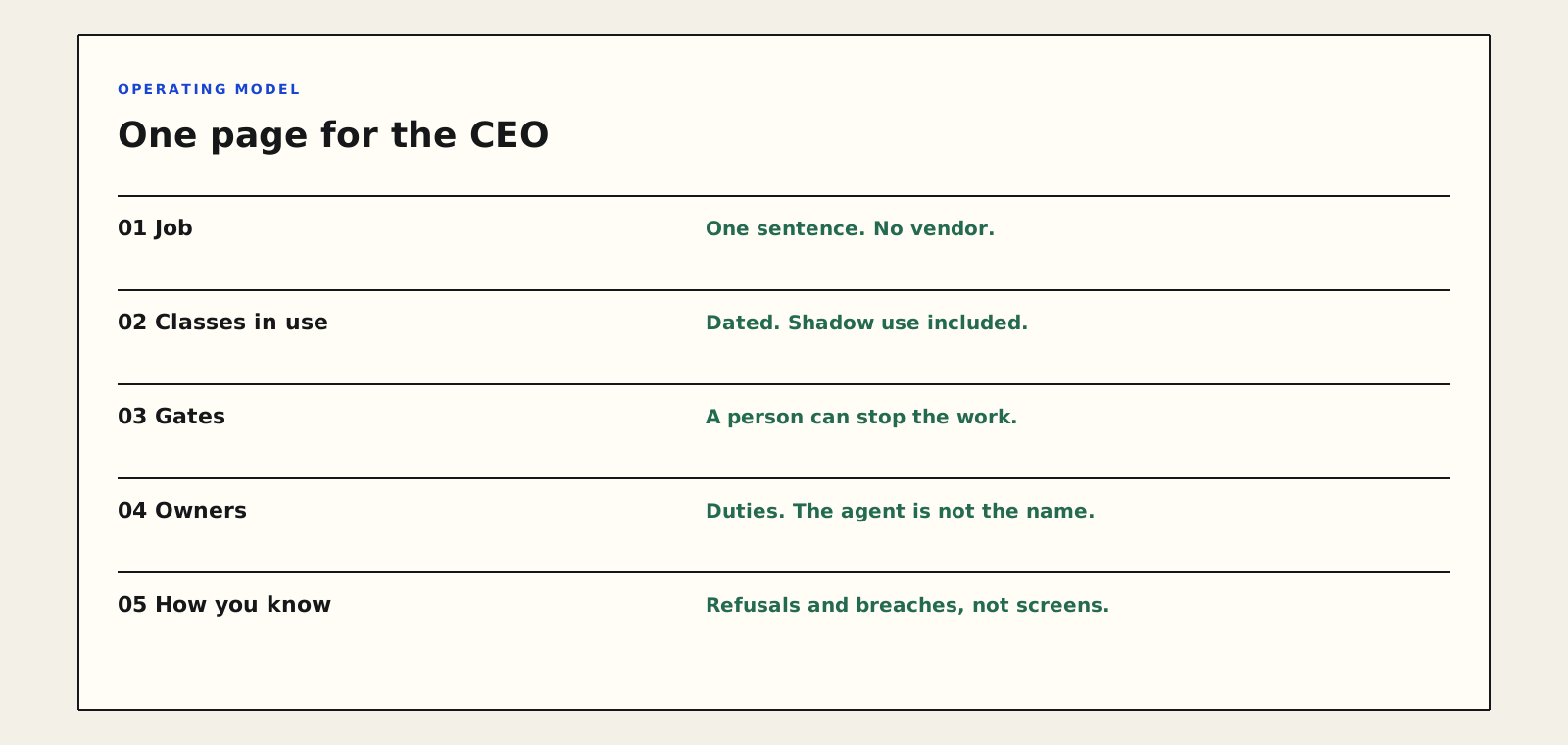
Five lines, and nothing that asks a CEO to choose a vendor. Fill it from your inventory. This figure is the structure, not an example from a company.
Section 07
A good page and a tool-rollout page
The failure mode that looks like success is more screens, or a mandate nobody reviews. Both can be reported as adoption. Neither is an operating model. Use the contrast before you send the page upward.
Good: classes in use, dated, with shadow tools included
Good: one practice gated, and the gate has stopped something
Good: refusals, breaches, and a named human on what ships
Good: harness, review, system, ethics, and permission as duties
Good: a written refusal, and the designer-track course for the craft
If the page can be answered by a purchase order, it is the wrong page.
Section 08
A prompt that drafts the page, not the decision
An agent can assemble the sheet from notes you already trust. It cannot decide the job, and it cannot sign the permission. Give it the inventory and the refusals. Tell it what to leave out. Read the draft as a head of design, not as a spectator.
If the model puts a product name in the job sentence, delete it. If it counts screens, delete the measure. If it recommends a certificate, a cohort, or a faculty as the plan, delete that too. Those belong to a different product.
You are drafting operating-model.md for a head of design.
Read only inventory.md and gates/research.md.

Output five blocks, in this order, and nothing else:
1. Job. One sentence. No product name. No vendor.
2. Classes in use. Name the class. Mention an example only if inventory.md dated it. Include shadow use.
3. Gates. Only practices that gates/ already describes. Mark the others as not yet opened.
4. Owners. Duties, not new job titles. The agent is never the name on the work.
5. How you know. Measures of judgement, refusal, or breach. Do not count screens, prompts, or seats.

Do not recommend a tool, a certificate, a cohort, or a price.
If a block cannot be filled from the notes, write "not yet" and stop.
Section 09
What you will not count as done
A tool list is not done. A demo is not done. A gate that has never stopped anything is not a gate yet. A measure that rises when the team generates more screens is the false success in a new costume. Research claims that cite a persona are not evidence, and the page should say that even if research is not the practice you gated this quarter.
Do not ask the CEO to choose a vendor inside a class, to supply taste, or to decide whether synthetic users count. Those are design decisions. Ask the CEO for the judgement budget, for the systems an agent may touch, and for acceptance of the human who answers. The longer leadership course on this site walks that page. The short course for the CEO is the ask, not a substitute for it.
Risk sits where permission is vague. Client material in a prompt, invented footage treated as a casual export, computer use on a live tool with no list: those are not slides to admire. They are the reason the permission file exists. This article is not a legal opinion. The questions go to counsel with a date on them.
Section 10
Ninety days, then the course
Weeks one and two are an honest inventory. List the classes already running, including the browser tab procurement does not know about. Name the person and the system. Do not turn the list into a purchase order. The phase is done when the list is honest.
Weeks three to six pick one of the four practices. Write the harness for that practice only. A person holds the gate. If the gate has never stopped anything, it is not a gate yet. Leave the other three for later, on purpose.
Weeks seven to twelve put review time on the calendar and sign who may run which class, on which repos and data. Name what an incident is. That is a permission rule, not a mandate to adopt a tool. Then write the one page.
If you are the person who has to hand that page to a CEO, the course walks the same sequence: the job in one sentence, the classes already running, including the browser tab, one gate that has stopped something, the ninety days, and the page itself. US$300 opens that course together with the quality bar and the short briefing for the executive who has to fund the judgement. A general certificate will not name which class may run in your organisation on Monday. Designer membership does not include these courses.
Projects to inspect
Sources
Sources & further reading
- Leading a Design Organization with Agents
The course whose operating model this article describes.


