Section 01
Volume is not a quality story
The week feels productive. More screens, more variants, more synthesis notes, more prototype files. The critique calendar did not grow. Nobody announced that the bar had moved. It moved anyway, because the same hours now cover a larger pile, and the work that arrives without a packet consumes the first ten minutes of every slot.
That is the practical problem for a head of design who already sees the volume. Generation is no longer the constraint. Critique is. A design system that cannot refuse an invention becomes the instruction the next agent follows. A research note that calls a synthetic user a finding will reach a roadmap if nobody writes the line down. Permission questions about client material, likeness, and computer use will be answered by whoever is nearest the prompt, which is not a policy.
This essay is the constraint, not the craft of running a critique. The designer-track course still teaches how to critique. Here the question is whether the organisation can refuse work, including agent work, and whether a named person will sign the page that says so.
Section 02
Four constraints, one signature
Hold four ideas at once, or the page you sign will be a slogan. First, critique hours are a capacity plan. You estimate them for one team, with your own minutes, not a universal ratio borrowed from a talk. Second, the design system is the control plane. Tokens, components, and the written system are what agents will follow. Scaling a second team before that system can decline an invention is how a brand drifts. Third, desk research can go faster. Participants, consent, and interpretation cannot be simulated and then called evidence. Fourth, design does not decide the law. It brings counsel a dated list: client material, likeness and brand, which systems an agent may open, and who answers.
The signature is the fifth move. Owners for critique, the system, research ethics, and permission. A quality bar those owners can enforce. A permission list that is deny-by-default. An incident path that can stop an artifact, name the failed gate, and write the fix back. Three lines stay off that signature and go to the CEO: residual risk, critique time rather than a savings claim, and what the company will say in public.
None of this is a legal opinion. If a sentence on the page sounds like the company accepts the risk, signed by the head of design, strike it. That sentence is the overreach. Counsel and security are partners in the permission questions. They are not the students of the course.
Section 03
Certificates do not sign your bar
A generic AI leadership certificate will teach governance as a topic. An executive AI program walks cybersecurity, compliance, and a capstone that is a plan or a pitch, and asks leaders to assess readiness across people, process, data, and governance before they plan an implementation. That is a coherent program for a general manager. It ends in a credential.
Your quality bar is not that credential. A certificate does not name the critique lead who can refuse a full week. It does not say whether a second team may turn agents on before the contribution path exists. It does not forbid a synthetic user as evidence in your roadmap packet. Those sentences have to be yours, in the team's language, where the people who ship can see them.
Use a certificate page to see the shape of a cohort product: duration, faculty, live sessions, a price, a certificate. Then come back to the page you would actually sign. If the two documents could be swapped, you have written a brochure.
Section 04
Case study: the second team asks
A composite, not a client. One product squad has been using agents for a month. The work is uneven and mostly honest: packets are attached, a reviewer is named, and two pieces were refused because the criteria were not met. A second team asks to turn the same tools on. They do not ask for a critique slot. They ask for the login.
The system owner looks at what the first team has been generating. Three components are local copies of something the system already has. One token was invented because the file did not ban it. Plausible, on brand at a glance, and not accepted. The rule, written that week, is short. If the system already has it, compose it. If it does not, the contribution path is a proposal a person records, including a decline. Silence is not permission. The second team waits until that path has been used once, including a recorded no.
In the same fortnight a research summary lands with a sentence the model wrote because it sounded like the theme. It is kind, specific, and untrue. The ethics owner sends it back. The roadmap item keeps the desk-research label. The user bet waits for a signed packet: consent, a named interpreter, and a sentence that says what would falsify the claim. The incident, if you need the word, is small. The artifact stops. The failed gate is named. The fix is written back into the packet template so the next summary cannot skip the line.
Section 05
Where the hours and the rules live
Put the capacity plan, the contribution rule, the research line, and the permission questions in files a cold reader can open. The governance note points at them. It does not restate every example. Product names, if they appear, stay in the inventory with a date. The note names classes and systems for this period and leaves the rest off.
The critique plan is for one named team. Artifact classes, this team's own time estimates marked as estimates, the reviewers, and the hours protected on the calendar. The gap is a choice: fewer artifacts in, more protected hours, or a refuse-when-full rule. Agent speed does not add hours.
quality/
  critique-capacity.md     # one team, artifact classes, hours, refuse-when-full
  system-rule.md            # compose if it exists; contribution path if it does not
  research-line.md          # desk research versus participant evidence
  permission-questions.md   # for counsel: material, likeness, systems, who answers
  governance-note.md        # owners, bar, permission list, incident path
  ceo-asks.md               # residual risk, critique time, public claims
Section 06
The note, before anyone signs it
Read the sheet as information architecture. Four duties a person can refuse with. One incident path. Nothing that pretends the head of design has settled the CEO's residual risk. If a name is missing, the page is not ready. If a duty cannot refuse anything, it is a title.
The figure is blank on purpose. A filled example from a fictional company would teach the wrong lesson, which is that someone else's names will do. Write your own. The course Quality, Systems, and Accountability is the sequence that gets you there, module by module, without turning the permission list into legal advice.
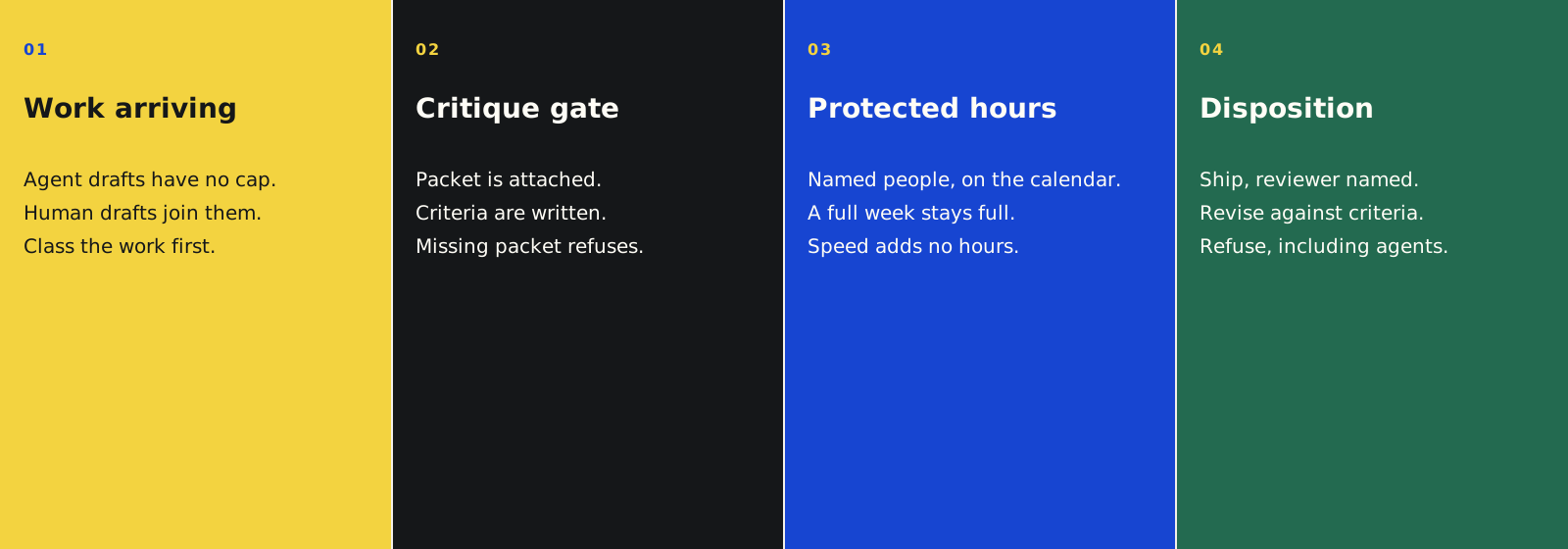
Work arrives from agents and from people into one queue. The gate can refuse a missing packet. Protected hours do not grow because generation got faster. Someone owns the call.
Section 07
What belongs on the signed page
The governance note is the artifact. It is short enough to sign and specific enough to refuse with. The lower band is a set of asks, not a set of decisions the head of design has already made.
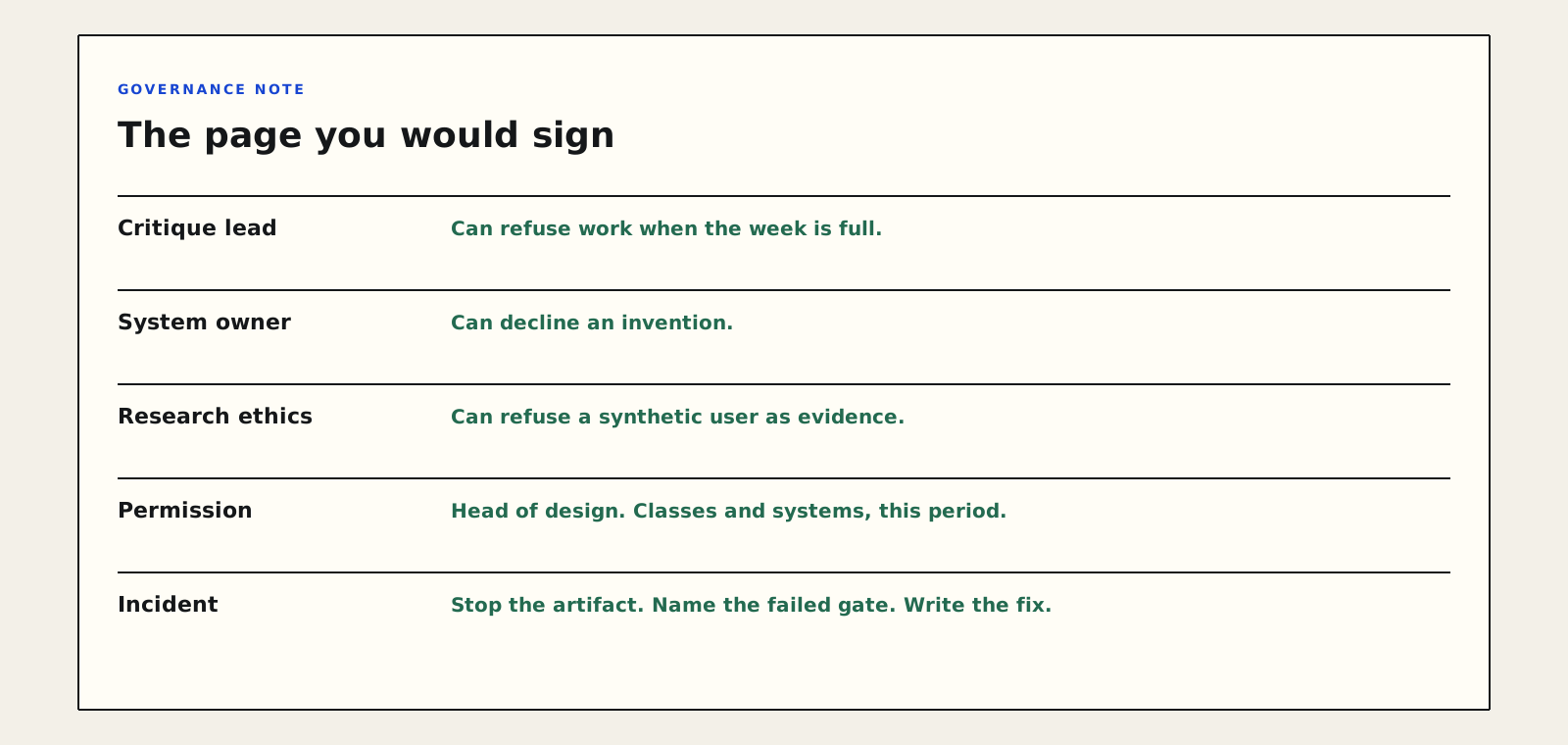
Structure only. Names, systems, and the actual permission list come from your organisation. The incident line is a path, not a slogan.
Section 08
A bar that can refuse, and a bar that only nods
Adoption reports hide inside quality language. More artifacts reviewed can mean the bar got softer. A system that never records a decline is not a control plane. A research packet that says users told us above a stack of public pages is a labelling failure, and it is a leadership failure if the executive summary is where the labels die.
Good: named people and protected hours on the calendar
Good: the gate refuses it before a senior person opens the file
Good: compose what exists; record a decline when it does not
Good: desk research keeps its name; a user bet needs a signed packet
Good: that line is an ask for the CEO, not a signature
If nothing can be refused, the page is a status meeting.
Section 09
A prompt that drafts the note from your files
Let an agent assemble the note from the four files you already trust. Forbid it from inventing owners, legal conclusions, or a savings claim. You still sign, or you send it back.
Read only quality/critique-capacity.md, system-rule.md, research-line.md, and permission-questions.md.

Write governance-note.md with four sections:
- Owners. Use names only if the files name them. Otherwise write the duty and "name due".
- Quality bar. One line each owner can refuse with, drawn from the files.
- Permission list. Classes and systems named in permission-questions.md. Everything else is off.
- Incident. Stop the artifact, name the failed gate, write the fix back.

Then write ceo-asks.md separately:
- Residual risk on the permission list.
- Critique time, not a savings claim.
- What the company will say in public.

Do not give legal advice. Do not write "the company accepts the risk".
Do not count screens or promise a smaller team.
If a section has no source in the files, write "not yet".
Section 10
Limits, and the course
This will not survive contact with a team that treats the note as a poster. The test is ordinary. Can the critique lead refuse a full week. Can the system owner decline a plausible component. Can research ethics stop a sentence that sounds like a user. Can permission name a system that is off. If the answers are theatrical, the page is not alive.
Do not use this as a substitute for counsel, for a security review, or for the designer-track courses that teach critique, systems, and research packets. Point authorship and disclosure at the school's existing article rather than inventing a second policy in the margin. The permission module is a list of questions. The law is not in it.
Quality, Systems, and Accountability is that sequence as written lessons. You leave with critique hours on a calendar, a rule for the design system before a second team turns agents on, a line that keeps a synthetic user out of the evidence, a dated list of questions for counsel, and the note you can sign.
Pay US$300 once and that course opens with the operating model and the CEO briefing. A general AI course can teach governance as a topic. It will not put your owners, your quality bar, and your incident path on a page. Designer membership does not include these courses.
Projects to inspect
Sources
Sources & further reading
- Quality, Systems, and Accountability
The leadership course this essay introduces.
- Design systems that maintain themselves
The designer-track argument for a system agents can follow, which this essay treats as a leadership gate.


