Section 01
Speed without accountability is not a practice
Agentic design makes it easy to produce artifacts faster than a studio can stand behind them. A campaign site, a student assignment, a client prototype, and a production settings page can all emerge from similar prompts. What differs is who is accountable when the work is wrong, biased, inaccessible, or quietly derivative.
Governance is not a vibe of caution. It is a small set of written rules about authorship, disclosure, verification, and escalation. Studios and campus programs that skip those rules eventually invent them under pressure — after a client complaint, a plagiarism case, or a shipping incident. Writing them while the team is calm is cheaper.
This article treats verification as the center of gravity. Generation is abundant. The scarce resource is a human who can say: I reviewed the evidence, I accept the residual risk, and my name is on the outcome.
Section 02
The mental model: signature, evidence, disclosure
Three questions cover most agentic design work. Who signs? What evidence did they review? What must be disclosed to whom? If you can answer those before the artifact leaves the studio, you already have a governance loop. If you cannot, you have a generation hobby.
Disclosure is contextual. Internal exploration spikes may need only a note in the project log. Client deliverables, graded campus work, published research, and regulated product surfaces usually need clearer statements. The point is not maximal confession. The point is that recipients can calibrate trust.
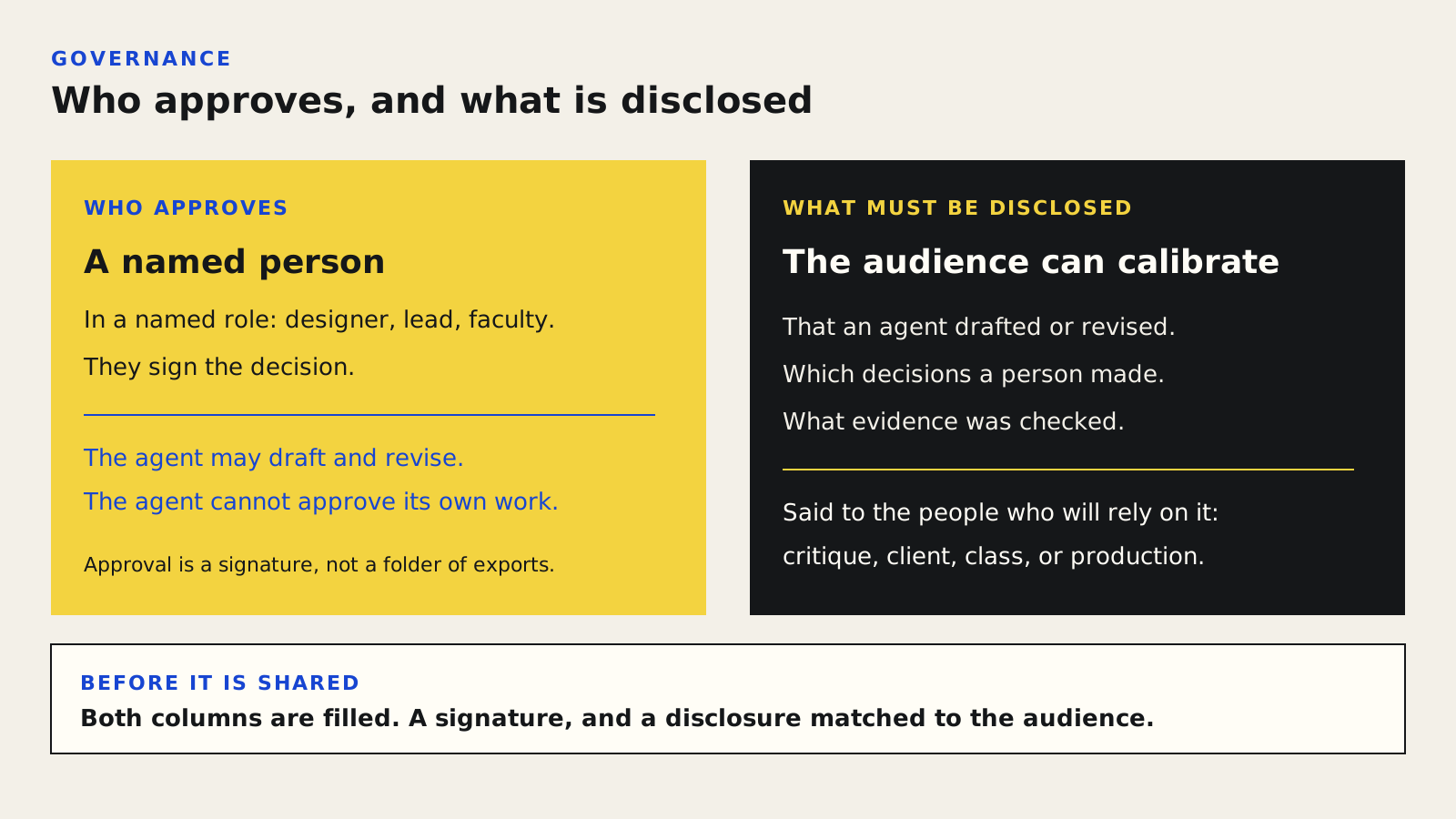
A named person in a named role signs. Disclosure says what the agent did, what the person decided, and what was checked, for the audience who will rely on the work.
Section 03
What "authorship" means when agents draft
Authorship in a studio is about responsibility, not about who typed the first pixels. If a designer directs the brief, selects among alternatives, runs verification, and approves the ship, they author the outcome even when an agent wrote most of the JSX. If nobody reviewed evidence and the file shipped because it looked polished, the studio still owns the outcome — and the process failure.
Campus settings often need a stricter definition because assessment depends on learning evidence. Programs should say whether agents are allowed, for which assignments, and what students must submit besides the artifact: prompts, critique logs, reflection on revisions, and verification steps. Silent use helps no one.
Do not pretend agents are interns with moral agency. They do not hold professional liability. Humans and institutions do.
- Author = accountable human (or named role) for the shipped artifact.
- Contributor credit for agents is optional; accountability is not.
- Assessment contexts may require process artifacts, not only finals.
- Legal ownership of IP still follows contracts and local law — policy cannot invent that alone.
Section 04
Case study: campus studio review week
A design program ran a two-week product studio where students could use coding agents to prototype a campus services app. Midway, reviewers noticed three projects with near-identical navigation patterns and the same empty-state illustration structure. None disclosed agent use. Two students had substantially rewritten agent output; one had submitted almost raw generation.
The faculty response was process, not panic. They introduced a one-page disclosure form, a required critique log template, and a verification checklist (keyboard path, contrast spot-check, and a short oral defense of three design decisions). Grades shifted toward demonstrated judgment. The near-raw submission failed the oral defense. The rewritten projects passed with feedback on originality of information architecture.
The lesson for commercial studios is parallel: without logs, you cannot tell craft from coincidence, and without disclosure norms, you cannot teach or hire against a standard.
Artifact: services home v3
Agent passes: 2 generation, 1 a11y fix
Human decisions: IA rewrite, illustration replaced
Evidence: mobile screenshots + axe summary
Disclosure: agents used for scaffolding; IA human-authored
Signer: student lead + faculty reviewer
A critique log makes agent assistance inspectable without turning the studio into a surveillance theater.
Section 05
Disclosure decision matrix
Write thresholds down. Ambiguity produces inconsistent ethics under deadline pressure.
Log internally; disclosure optional externally
Disclose agent role in the critique log
Follow course policy; usually disclose + submit process artifacts
Disclose significant agent drafting unless contract says otherwise
Prioritize verification evidence; disclose per org risk policy
Disclose assistance consistent with venue rules
Disclosure level should track audience harm and evaluation stakes, not embarrassment about using tools.
Section 06
Critique logs that assign accountability
A useful critique log is short and evidentiary. It records what the agent did, what the human changed, what was verified, and what remains risky. It is not a transcript dump of every prompt.
# Critique log — [artifact name] — [date]

## Accountable owner
- Name / role:

## Agent assistance
- Tools used:
- Passes (generation / critique / a11y / other):
- What the agent materially produced:

## Human judgment
- Decisions accepted:
- Decisions rejected (and why):
- Original contributions (IA, copy, visuals, logic):

## Verification
- Screenshots / routes checked:
- Automated checks run (axe, eval, audit):
- AT / keyboard sampling:
- Residual risks:

## Disclosure
- Audience:
- Statement used:

## Signature
- I reviewed the evidence above and accept residual risk.
- Signed: _____________ date: _____________
Section 07
Studio and campus policy starter
Policy should be readable in five minutes. Long policies get filed. Short policies get used.
Agentic Design Studio Policy (v1)

1. Accountability
   Every external artifact has a named human owner.

2. Allowed use
   Agents may draft UI, copy alternatives, and critique.
   Agents may not be the final reviewers of their own work.

3. Verification before share
   Required: screenshots at agreed viewports, design-system check,
   accessibility automated scan on interactive work.
   Required for release: human keyboard sample on critical paths.

4. Disclosure
   Internal critiques: note agent assistance in the critique log.
   Clients and graded work: use the disclosure matrix.

5. Prohibited
   Fabricating user research quotes.
   Claiming WCAG conformance from automation alone.
   Submitting client work without a signed critique log.

6. Escalation
   Legal, safety, biometric, or discriminatory-impact questions
   go to [role] before shipping.
Section 08
Good vs bad governance habits
Governance fails in culture before it fails in documents.
Good: allow with verification + disclosure rules
Good: name human owner and what they verified
Good: evidence packets and signed decisions
Good: critique log required on share/release
Good: treat disclosure as calibration for the audience
Prefer inspectable practice over performative bans or blanket permission.
Section 09
Verification over generation
Studios often invest in better prompts while under-investing in review rituals. Invert that ratio as stakes rise. High-stakes surfaces should spend more calendar time on evidence and decisions than on another generation pass.
Tie tools you already use — DESIGN.md, visual evals, a11y-in-the-loop, bidirectional sync boards — into the governance story. Policy without harnesses becomes hypocrisy; harnesses without policy become unowned machinery.
- No share link without a critique log entry.
- No production merge without named owner on the PR.
- No campus grade without process artifacts when agents were allowed.
- No conformance marketing claims without an evidence plan.
Section 10
Risks and limits of governance theater
Over-disclosure can become noise; under-disclosure becomes deceit. Pick thresholds and revisit them quarterly. Surveillance-style prompt logging can chill learning without improving quality — prefer outcome evidence and short reflections.
Policies do not travel unchanged across jurisdictions, unions, clients, and accreditation bodies. This article is practice guidance, not legal advice. Have counsel review anything that touches contracts, IP assignment, accessibility claims, or student assessment rules.
Agents will keep getting faster. That does not reduce the need for signatures. It increases the volume of work that needs them.
Section 11
Reusable governance workflow
Use this workflow whenever agent-assisted design leaves the private scratch folder.
1. Name the accountable owner before generation starts
2. Generate / revise with agents as tools, not authors
3. Build a verification packet (screens, checks, open risks)
4. Hold a human decision pass; record accepts/rejects
5. Complete the critique log and signature
6. Apply the disclosure matrix for the audience
7. Archive the log with the artifact version
8. Escalate residual legal/safety questions before release
Sources
Sources & further reading
- EDUCAUSE Generative AI resources
Higher-ed oriented guidance collections for teaching and institutional GenAI practice.
- OECD AI Principles
International principles emphasizing accountability, transparency, and human-centered values.
- W3C WAI accessibility fundamentals
Reminder that accessibility claims require process and evidence, not tooling slogans.
- agents.md
Project instruction convention useful for encoding verification expectations agents must follow.
- Anthropic: Claude Code best practices
Practical agent workflow guidance that pairs with human review gates.


